For many families and even many educators, the terms phonemic awareness, phonological awareness, and phonics can blur together. They all relate to learning to read, they all involve sounds in some way, and they are often taught during the same early elementary years. However, they are not interchangeable. Understanding the differences matters, because when adults know what skill a child is actually working on, they can give more precise support.
Phonemic awareness is especially important because it sits at the bridge between spoken language and printed words. Before a child can map letters to sounds efficiently, the child has to notice that words are made of smaller sound parts. Research reviews from the National Reading Panel and the National Early Literacy Panel have shown that phonemic awareness and closely related code-focused skills are strongly tied to later reading and spelling outcomes. That does not mean phonemic awareness is the only key to reading, but it does mean that weak instruction or weak development in this area can make early decoding much harder.
What Is Phonemic Awareness?
Phonemic awareness is the ability to hear, identify, and manipulate the smallest sounds, or phonemes, in spoken words. It is an oral and auditory skill, not a print task. A child demonstrating phonemic awareness may blend the sounds /m/ /a/ /p/ into map, segment ship into /sh/ /i/ /p/, or say mile when asked to say smile without the /s/. That means the child is working with sounds in spoken language, even if no letters are visible.
This is the most concise way to separate phonemic awareness from phonics: phonemic awareness happens in the ears and mouth, while phonics connects those sounds to letters on the page. A child can have a phonemic awareness lesson with eyes closed. In contrast, a phonics lesson requires graphemes, letter patterns, or written words. That distinction matters because some children look successful in print-based activities while still having weak control over the individual sounds inside words.
Within phonemic awareness, the strongest instructional targets are the sound-level actions children need for beginning decoding and spelling. The three most central moves are blending, segmenting, and manipulating sounds.
Core Skills Within Phonemic Awareness

These skills are not equally easy. Identifying a first sound is generally easier than deleting or substituting a medial sound. That is one reason instruction should move from simpler tasks to more complex ones. It is also why rhyme practice alone is not enough. Rhyming sits under the wider umbrella of phonological awareness, but children eventually need to work at the phoneme level if they are going to decode efficiently.
Why It Matters for Learning to Read
The reason phonemic awareness matters is that alphabetic writing systems ask children to connect sounds in spoken words to letter spellings. The National Reading Panel concluded that phonemic awareness instruction improves phonemic awareness itself and also transfers to reading and spelling outcomes, with a large effect on phonemic awareness measures (d = 0.86), a moderate effect on reading (d = 0.53), and a moderate effect on spelling (d = 0.59). Those are not tiny classroom effects. They are strong enough to show that this skill is a meaningful part of effective beginning reading instruction.
The National Early Literacy Panel reached a compatible conclusion from a different angle. Its review found that phonological awareness and alphabet knowledge were among the strongest early predictors of later conventional literacy, and that code-focused interventions produced meaningful improvements across early literacy and reading-related outcomes. Together, these findings suggest that children do not simply “pick up” sound structure by exposure alone. Many benefit from deliberate, explicit instruction.
Researchers such as Linnea Ehri have connected phonemic awareness to orthographic mapping, the process by which readers form secure links among a word’s spelling, pronunciation, and meaning in memory. In practical terms, this helps explain why children who can hear and manipulate phonemes are better prepared to store words for fast, automatic recognition. Phonemic awareness is not the whole reading rope, but it is one of the strands that helps children become accurate and fluent readers.
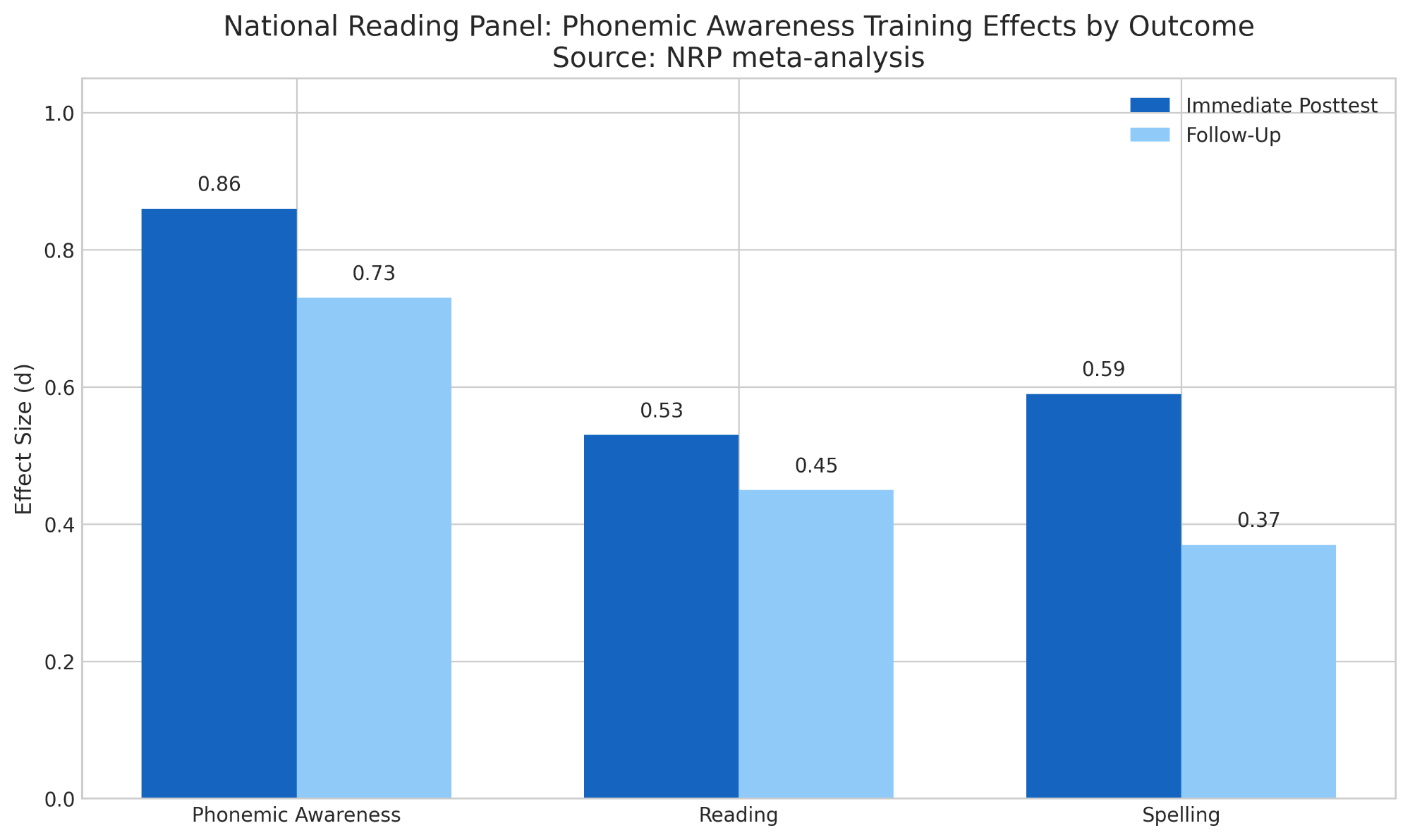
The chart above is useful because it shows both the strength and the limits of phonemic awareness instruction. The largest direct impact was on phonemic awareness itself, which is what we would expect. Even so, the transfer to reading and spelling remained meaningful, which is why phonemic awareness should be treated as a foundational component of instruction rather than as an isolated warm-up with no academic payoff.
Phonemic Awareness Activities
When parents and teachers search for phonemic awareness activities, they usually want tasks that are short, simple, and effective. The good news is that some of the best activities require very little setup. The most important principle is that phonemic awareness starts without print. Children first practice hearing and moving sounds orally, and then those sound skills are bridged to letters and words as soon as they are ready.
Strong daily routines are usually brief. A focused five- to ten-minute block can be enough when it is explicit and consistent. The National Reading Panel reported that phonemic awareness instruction did not need to be lengthy to work well, and many of the strongest effects appeared in shorter total training ranges rather than in very extended programs. That should reassure adults who worry they need an elaborate literacy center to make progress.
Daily Quick Wins That Fit Into Real Life
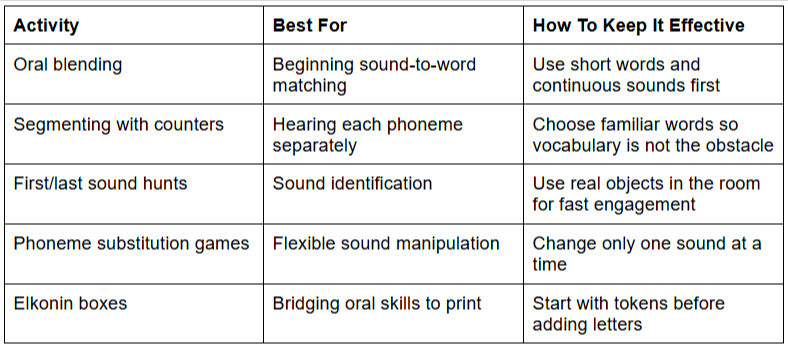
One useful activity is oral blending. The adult says the sounds slowly, such as /s/ /a/ /t/, and the child says the whole word, sat. Another is segmenting with counters, in which the child moves a token for each sound they hear in a word. A third is the first- or last-sound hunt, where a child looks for objects that begin or end with a target sound. A fourth is phoneme substitution, where changing one sound builds a new word family, such as map, tap, cap, and lap.
Elkonin boxes remain especially useful because they make sound units visible without asking children to decode full text. A child pushes one token into each box for each phoneme in a spoken word. The task becomes even more powerful when it moves from oral work to letter-sound mapping. A child might first push three counters for /m/ /a/ /p/, then replace the counters with the letters m, a, and p once the oral task is secure.
Scaffolds and Differentiation
Not all children should begin at the same point. For many learners, it helps to start with continuous sounds such as /m/, /s/, and /f/ because they are easier to stretch and hear. Stop sounds such as /t/, /p/, and /k/ can be harder for beginners to isolate. It also helps to begin with two- and three-phoneme words before moving to longer words, consonant blends, or more complex spellings.
For English learners, preteaching word meanings can lower the language load so that the child’s attention stays on the sound task. Modeling mouth movements can also help. For children at risk for dyslexia or other reading difficulty, daily explicit work on blending, segmenting, and manipulating phonemes is especially important because these are the very moves children need when words do not come easily.
Progression and Timing
A developmentally sensible sequence begins broad and becomes precise. In preschool, many children work on larger sound units such as rhyme, alliteration, and syllables. In kindergarten and first grade, the instructional focus should move firmly toward phoneme-level blending, segmenting, and manipulation. The National Early Literacy Panel noted that along the phonological awareness continuum, tasks involving deeper analysis tend to be stronger predictors than simpler identity tasks, and rhyme tends to be one of the weaker predictors on its own.
That matters because some early literacy routines stop too early. If children spend months clapping syllables and identifying rhymes but rarely segment or blend phonemes, they may seem busy without gaining the exact awareness needed for beginning decoding. The transition to print should happen as soon as children can manage simple oral blending and segmentation with some consistency.

Phonological Vs Phonemic Awareness
The question phonological vs phonemic awareness is really a question about level and scope. Phonological awareness is the umbrella term for awareness of the sound structure of spoken language. It includes larger units such as words in sentences, syllables, onset-rime patterns, and rhyming parts. Phonemic awareness is the most fine-grained level inside that umbrella. It focuses only on individual phonemes.
A useful way to picture the relationship is as a hierarchy. Children often begin with awareness of larger chunks because those are easier to hear. They may notice that banana has three syllables before they can segment bat into /b/ /a/ /t/. That is normal. However, decoding in an alphabetic language eventually demands access to the phoneme level, because letters and letter groups represent phonemes, not just syllables or rhymes.
Practical Implications of The Hierarchy
This distinction matters in instruction because some activities build a general listening foundation, while others prepare children directly for word reading. Clapping syllables in banana is phonological awareness. Identifying that cat and cap share the first two phonemes is phonemic awareness. Both have value, but they do not contribute in exactly the same way or at the same point in reading development.
The National Early Literacy Panel found that rhyme was consistently among the weaker phonological predictors when compared with more analytic tasks, and that analysis tasks were stronger predictors than simpler synthesis or identity tasks in some outcomes. That does not mean rhyme should disappear from early childhood. It means adults should not mistake rhyme mastery for full readiness to decode. Children need to move beyond broad sound play into explicit work with phonemes.

Phonics Vs Phonemic Awareness
The phrase phonics vs phonemic awareness often appears when parents are trying to figure out what their child is missing. The clearest answer is this: phonics teaches the relationship between graphemes and phonemes in print, while phonemic awareness teaches children to hear and manipulate phonemes in speech. One happens with letters and words on the page. The other can happen entirely through listening and speaking.
Phonics instruction might ask a child to read the printed word sat, identify that the letter s spells /s/, or blend the graphemes together to read the word. Phonemic awareness instruction might ask the same child to listen to /s/ /a/ /t/ and say the whole word without seeing any letters. Both are important, but they are not the same lesson.
How These Two Skills Work Together in Instruction
In practice, the best early instruction usually connects the two rather than isolating them for long periods. The National Reading Panel reported that phonemic awareness instruction often had stronger transfer when sound work was linked with letters. That finding fits with what classroom teachers often see. Oral practice helps children notice the sound structure of words, and print gives them a stable way to map those sounds.
A strong lesson sequence might begin with oral blending: the teacher says /s/ /a/ /t/, and the child says sat. Then the teacher shows the letters s-a-t and asks the child to read the word. Then the child writes it. This sequence moves from spoken language to print in a way that supports the alphabetic principle, the insight that letters represent sounds in words.
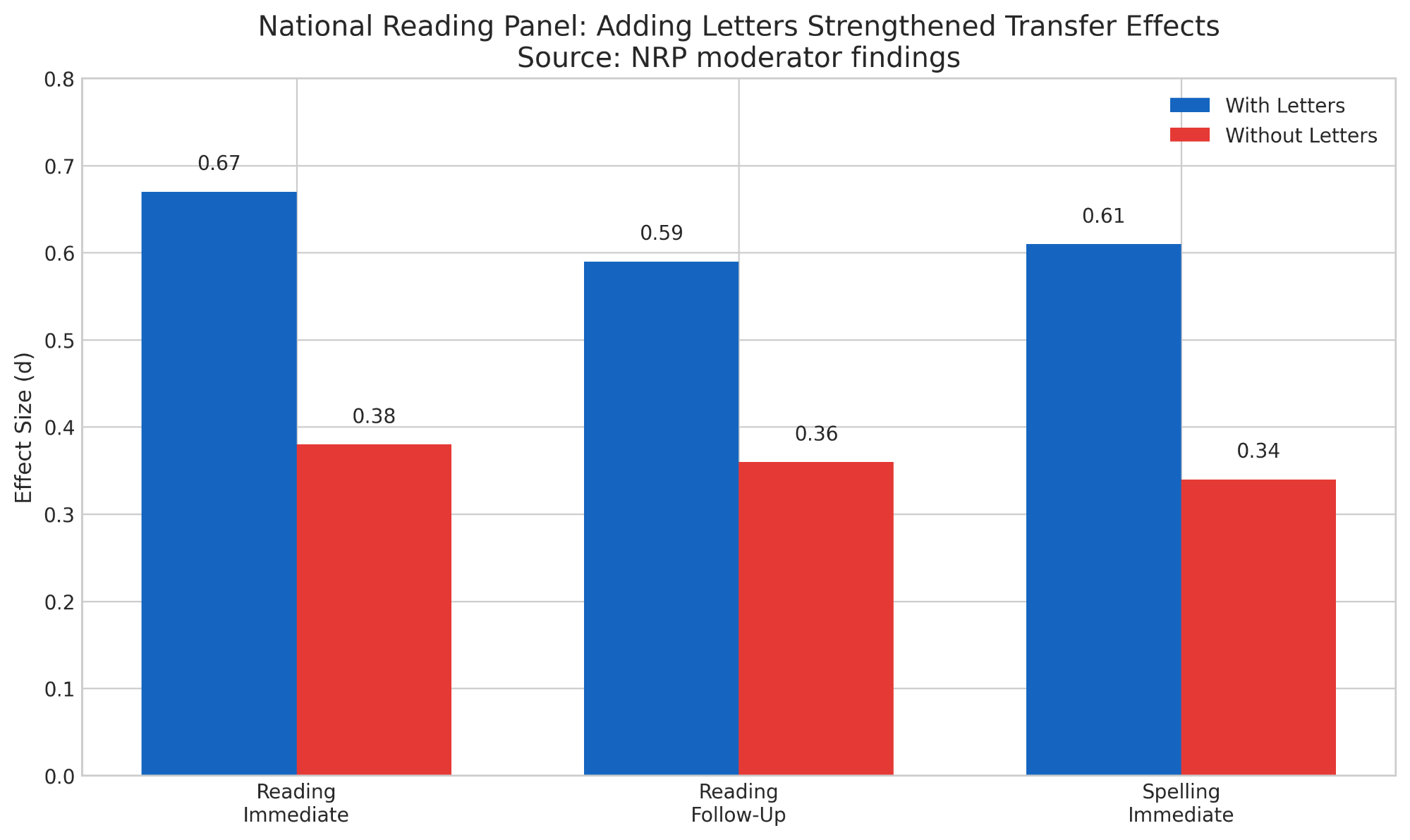
This pattern helps explain why strong beginning instruction rarely stays oral for long. Once children can hear and manipulate phonemes, linking those phonemes to graphemes increases the likelihood that the practice will transfer into real reading and spelling growth.
Phonemic Awareness Vs Phonics
For many caregivers, the question phonemic awareness vs phonics is less about formal definitions and more about what they should actually do next. From a family-facing perspective, phonemic awareness comes first in the sense that children must notice the sounds in words before they can map those sounds well to letters. At the same time, this does not mean adults must wait until phonemic awareness is “finished” before introducing phonics. The two can and often should develop together.
A simple lesson arc makes the relationship visible. First, the child orally blends /m/ /a/ /p/ into map. Next, the child reads the printed word map. Then the child spells map with letters. Finally, the adult asks the child to change /m/ to /t/ and make tap. In one short sequence, the child practices oral sound awareness, printed decoding, spelling, and sound manipulation.
Common Misconceptions Parents and Teachers Hear
One common myth is that rhyme work is enough to build the whole foundation for reading. In reality, rhyme is only one part of broader phonological awareness, and it does not replace phoneme-level work. Another myth is that children must master every oral sound task before they ever see letters. The evidence does not support that strict separation. In fact, the National Reading Panel found that phonemic awareness instruction paired with letters often had stronger effects on reading transfer than instruction without letters.
A third misconception is that phonemic awareness is only relevant for children already identified with dyslexia. In truth, phonemic awareness is a core beginning reading skill for most learners. Some children acquire it more quickly than others, but it is not a niche intervention topic. It belongs in mainstream early literacy instruction.
Phonemic Vs Phonological Awareness
The question phonemic vs phonological awareness is the quick recap version of the hierarchy explained earlier. If you want the shortest possible distinction, it is this: phonological awareness includes many kinds of sound awareness, while phonemic awareness refers specifically to awareness of individual phonemes. Every phonemic awareness task is phonological, but not every phonological task is phonemic.
This distinction becomes clearer through examples. Clapping the syllables in banana is phonological awareness. Generating a rhyme for cat is phonological awareness. Segmenting ship into /sh/ /i/ /p/ is phonemic awareness. Deleting the first sound in pies to make eyes is also phonemic awareness. The last two are closer to the kind of sound control children need when they decode unfamiliar printed words.
Assessment Snapshots That Clarify The Difference
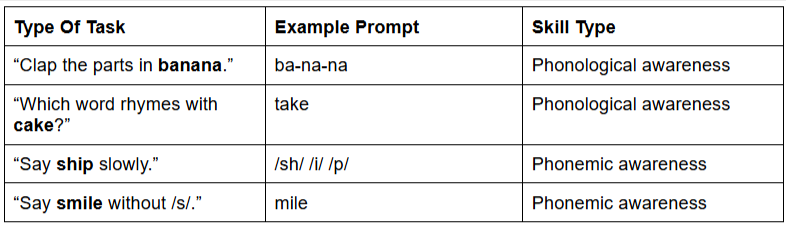
These snapshots also show why assessment should match the skill being taught. If a child can clap syllables but cannot blend three phonemes into a CVC word, the child is not yet ready for adults to assume sound awareness is secure. Assessment has to look at the most instructionally relevant level.
Impact on Reading Development and Red Flags
Phonemic awareness supports reading in at least three related ways. First, it helps children decode because they can hear the sound sequence they are trying to map to letters. Second, it supports spelling because spelling requires breaking a spoken word apart and matching each phoneme to a grapheme or grapheme pattern. Third, it supports the repeated sound-spelling connections involved in orthographic mapping, which later supports fluent word recognition.
This is also where early screening matters. Children do not need to be in serious distress before adults respond. The National Reading Panel noted that children at risk for reading failure often showed especially meaningful gains from phonemic awareness instruction. That suggests that waiting for prolonged failure is the wrong move. Preventive action is often more effective than later remediation.
Signs Adults Should Watch Closely
A child may need additional support if the child consistently struggles to blend simple CVC words orally, cannot identify first or last sounds in familiar words, or shows persistent difficulty segmenting words into sounds by the middle of kindergarten or first grade. A child who can memorize books, letters, or routines but still cannot hear that map and mat differ in the final sound may be signaling a foundational gap.
It is important not to overdiagnose from one weak day or one imperfect task. Children vary, and some need more modeling. However, ongoing difficulty with phoneme blending, segmentation, and manipulation should not be dismissed as immaturity if it continues across guided practice. Children with weak phonological processing may be at greater risk for later difficulty, including dyslexia, especially when that weakness appears alongside slow progress in letter-sound learning and decoding.
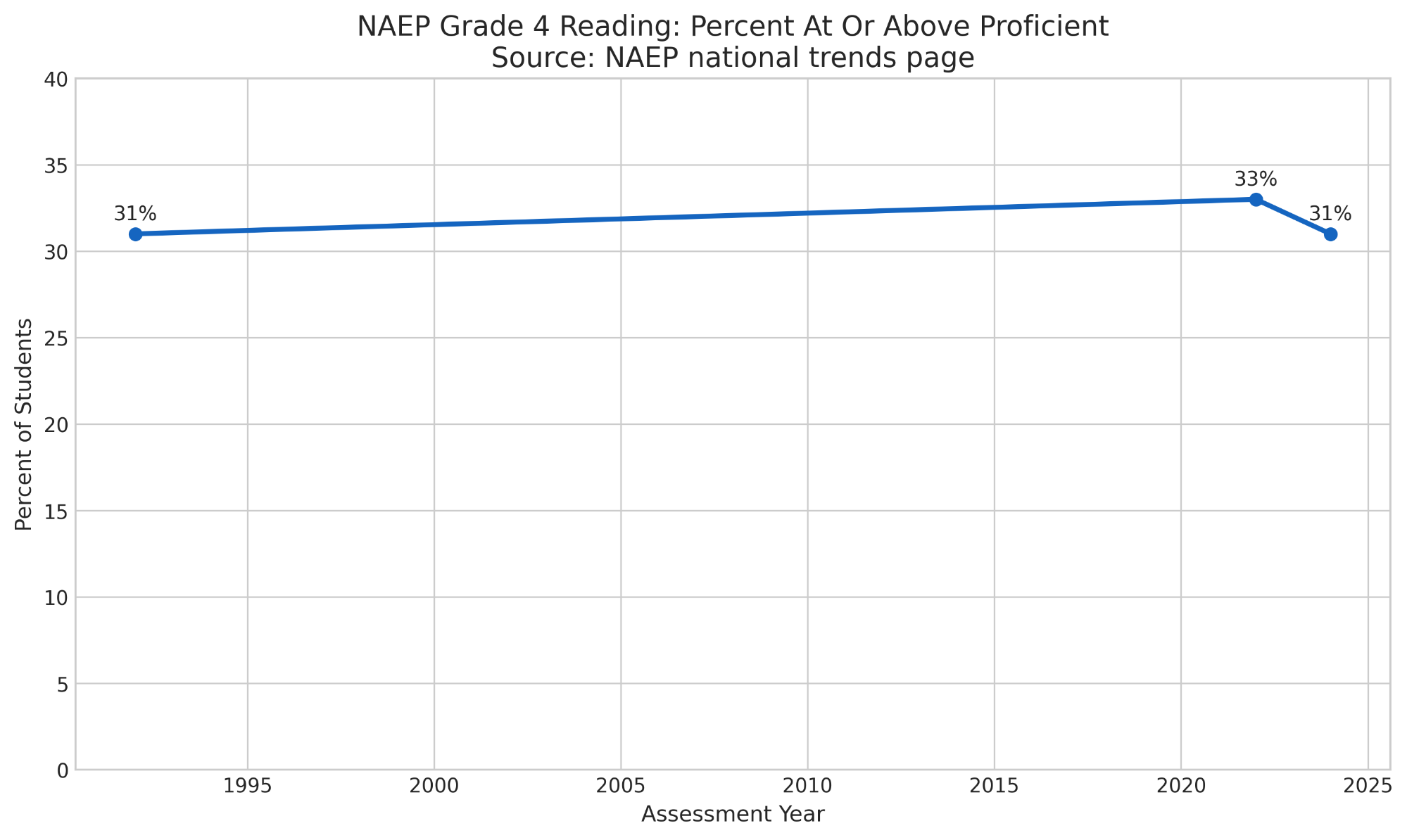
This national context chart should be read carefully. It does not prove that phonemic awareness alone explains reading outcomes, because reading achievement reflects many influences, including instruction quality, vocabulary, language comprehension, opportunity to learn, and intervention access. Still, it underscores why strong foundational instruction in the earliest years matters so much.

Bridging From Sounds to Print (Alphabetic Principle and Orthographic Mapping)
The next major step after oral phonemic awareness is bridging from sounds to print. This is where the alphabetic principle becomes concrete. The alphabetic principle means that letters and letter combinations represent sounds in spoken words. Children do not just need to know isolated letter names. They need to understand that a printed word is a sequence of spellings that corresponds to a sequence of phonemes.
Orthographic mapping builds on that principle. Ehri describes orthographic mapping as the formation of letter-sound connections that bond the spellings, pronunciations, and meanings of words in memory. In parent-friendly language, this is how words become familiar enough to read quickly by sight without guessing. It is not rote visual memorization. It is the result of repeated accurate connections between phonemes and graphemes.
A Simple Classroom or Home Sequence
A strong bridge-to-print routine can follow a four-step path. First, the adult says the target word orally and has the child segment the sounds. Second, the adult represents those sounds with letters or letter tiles. Third, the child reads the whole word. Fourth, the child writes or manipulates the spelling while saying the sounds aloud. This sequence keeps the spoken and printed forms connected.
The National Reading Panel found that phonemic awareness instruction combined with letters often produced larger reading outcomes than instruction without letters. The National Early Literacy Panel similarly found that code-focused interventions, many of which included phonological awareness and alphabet knowledge components, generated positive effects across foundational literacy outcomes. In other words, the transition from oral awareness to print is not an optional extra. It is the point where the reading system begins to lock in.
Tips for Teachers and Parents
The most effective support for phonemic awareness is usually simple, direct, and consistent. Short daily routines tend to work better than occasional long lessons. Familiar words tend to work better than abstract lists, because vocabulary confusion can hide what is really a sound-processing challenge. Oral tasks should be clear and brief, with one instructional goal at a time.
For teachers, it helps to build phonemic awareness into transitions, warm-ups, and small-group reading time. For parents, it helps to use playful, spoken routines during ordinary life. A car ride can become an oral blending game. A kitchen moment can become a first-sound hunt. A bedtime routine can include a quick sound-change challenge with a few familiar words.
Practical Guidance At A Glance
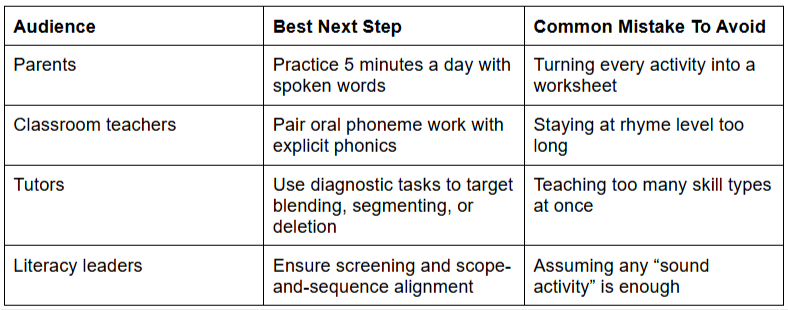
Adults should also know when to move forward. When a child can orally blend and segment two- and three-phoneme words with some confidence, that is the time to connect those sounds to letters immediately. Waiting too long can create an unnecessary split between oral work and actual reading. Strong instruction is not either-or. It is well-sequenced.
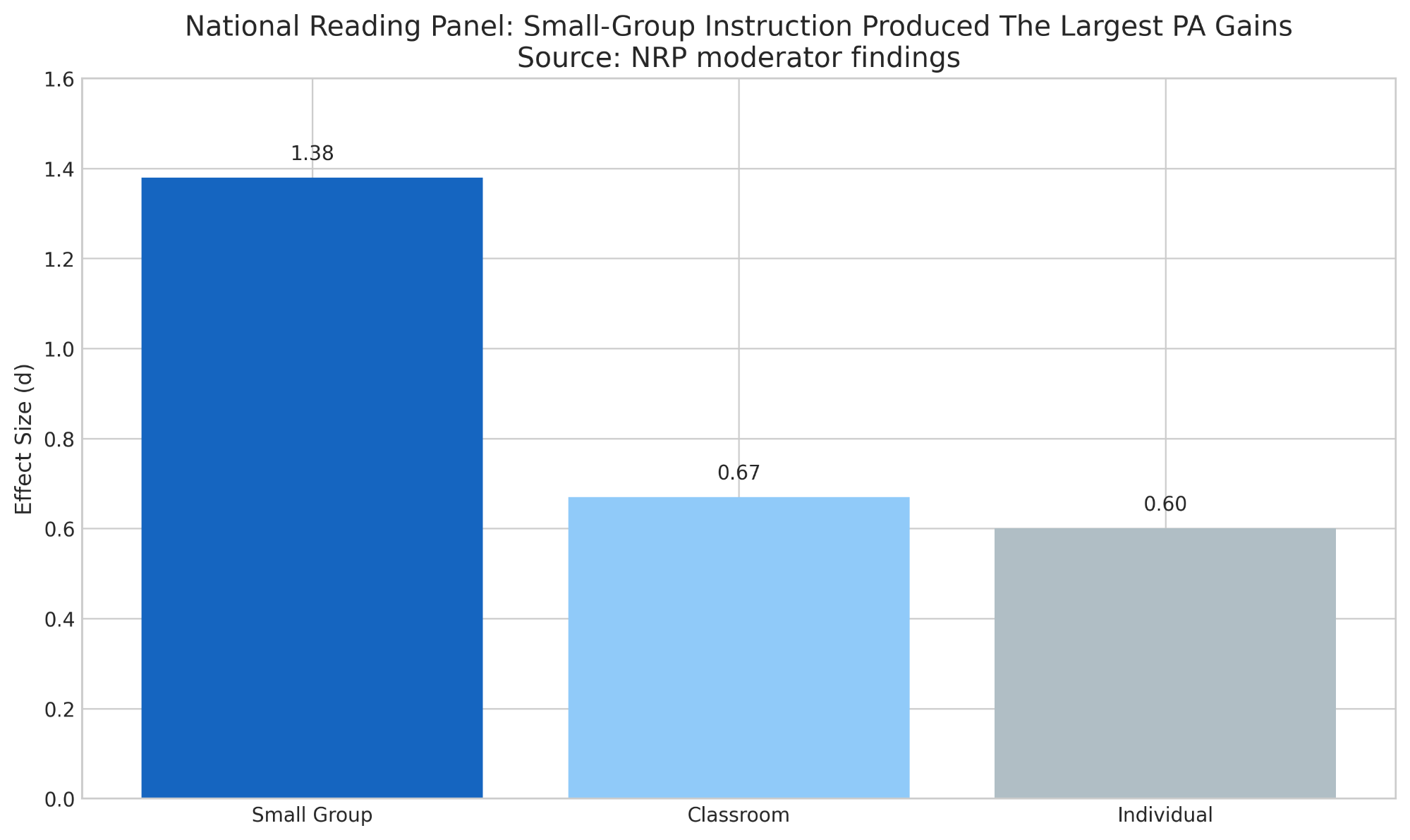
One reason this grouping chart matters is that it gives literacy teams a practical design insight. If a school is deciding how to intensify support for children who are not yet secure with blending and segmenting, small-group instruction may offer an especially efficient structure for guided practice, feedback, and correction.
“Orthographic mapping involves the formation of letter-sound connections to bond the spellings, pronunciations, and meanings of specific words in memory.” — Linnea Ehri
That single statement captures the central point of this article. Phonemic awareness matters because it helps children perceive the very sound structure that print represents. When adults teach those sound structures clearly, then connect them to letters systematically, they make the path into reading more transparent.
FAQ: Phonemic Awareness
What Is An Example Of Phonemic Awareness?
A simple example is asking a child to blend /c/ /a/ /t/ and say cat. Another example is asking the child to say smile without the /s/ and answer mile. Both tasks focus on spoken sounds rather than printed letters.
What Are The Key Skills In Phonemic Awareness?
The most important skills are isolating, blending, segmenting, deleting, and substituting phonemes. In practical early reading instruction, blending and segmenting are especially important because children use them directly when decoding and spelling.
What Is The Difference Between Phonological And Phonemic Awareness?
Phonological awareness is the broader umbrella that includes syllables, rhymes, onset-rime patterns, and phonemes. Phonemic awareness is the most specific part of that umbrella and focuses only on individual phonemes.
Is Phonemic Awareness The Same As Phonics?
No. Phonemic awareness is an oral language skill involving spoken sounds, while phonics teaches how letters and letter patterns represent those sounds in print. They are closely connected, but they are not the same.
Does Phonemic Awareness Come Before Phonics?
Phonemic awareness supports phonics, but the two do not need to be separated into completely different stages. Children often benefit most when oral sound work is quickly connected to letter-sound instruction.
At What Age Should Phonemic Awareness Develop?
Many children begin with broader phonological awareness in preschool and move toward stronger phoneme-level work in kindergarten and first grade. Development varies, but children who continue to struggle with blending and segmenting in kindergarten or first grade may need targeted support.