Choosing among phonics apps for kids is harder than it should be. Many products look engaging at first glance, but families and educators are not only buying screen time. They are trying to support one of the most important early academic tasks a child will ever face: learning how print maps onto speech so unfamiliar words become readable, spellable, and eventually automatic.
That is why the strongest phonics tools do more than entertain. They model sounds correctly, teach skills in a logical order, give children many chances to practice with decodable text, and help adults see what the child can already do and what needs review. The National Reading Panel concluded that systematic phonics instruction significantly improves reading outcomes when compared with approaches that teach little or no phonics. The What Works Clearinghouse likewise emphasizes linking speech sounds to letters, teaching decoding explicitly, and making sure students read connected text every day.
Readability is positioned in this brief as a phonics-forward reading app that combines explicit instruction, interactive practice, decodable reading, and adult-facing progress tracking. The article below explains how that model works, how it fits with the science of reading, and what parents and teachers should look for before they decide whether a phonics app deserves regular time in a child’s routine.
Phonics For Kids: What Should Parents And Teachers Look For First?
Phonics for kids works best when it is explicit, systematic, and connected to real reading. In plain language, phonics helps children connect letters and letter patterns to the sounds in spoken words so they can read and spell new words instead of guessing. That skill sits inside a larger reading system. Scarborough’s Reading Rope describes decoding-related skills such as phonological awareness, decoding, and sight recognition of familiar words as part of the word-recognition side of skilled reading.
A useful first distinction is the difference between phonemic awareness and phonics. Phonemic awareness is about hearing and working with sounds in spoken words. Phonics is about linking those sounds to letters in print. The National Reading Panel notes that the two ideas are related but not identical, and that school-entry phonemic awareness and letter knowledge are strong predictors of reading success in the first years of instruction. Good phonics instruction brings those pieces together instead of treating them as unrelated drills.
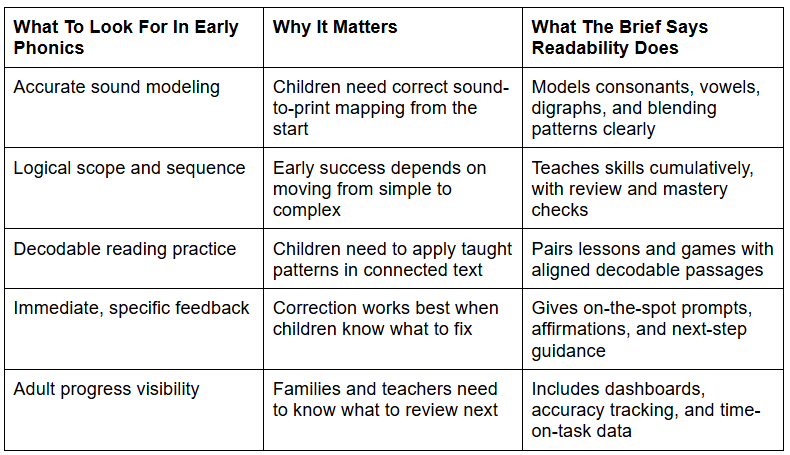
In practice, that means children need a clear scope and sequence. They should meet common consonants and short vowels before more complex vowel spellings. They should practice blending from left to right. They should read words and sentences that mostly contain the patterns they have already been taught. And they should receive feedback that helps them correct errors without feeling overwhelmed.
A parent or teacher can evaluate this quickly by asking four simple questions. Does the tool teach one new pattern at a time? Does it connect isolated practice to reading in text? Does it explain mistakes clearly? And does it show adults what the child has mastered? If the answer is yes, the tool is more likely to support real growth rather than short-lived app engagement.
Phonics Games: How Can Play Strengthen Decoding Without Becoming A Distraction?
A phonics app should feel like playing a game. The goal is not to keep children tapping for the sake of tapping. The goal is to make focused practice feel manageable, repeatable, and motivating.
Readability’s phonics feature reinforces letter-sound mapping, blending, segmenting, word building, and pattern recognition. Those mechanics matter because early readers need many brief, successful repetitions. A child might hear a sound, match it to a grapheme, drag sounds together to build a CVC word, then apply that same pattern in a short decodable sentence. When the game is aligned to instruction, the child is not switching contexts constantly. The activity is simply giving the brain another chance to strengthen the same connection.
This research-aligned design is especially important because cognitive load can derail young learners quickly. A good app introduces one new idea at a time, keeps instructions short, and avoids clutter that competes with print. That fits the broader evidence base on foundational reading instruction, which favors explicit, manageable teaching sequences over loosely connected activities.
The strongest game mechanics in a phonics environment usually include sound matching, tap-to-hear modeling, drag-to-blend tasks, and word-family practice with a small set of controlled words. What matters most is not the format itself, but whether the game points the child back to the target skill. If a child misses ship, for example, the app should not simply mark it wrong. It should help the learner hear that sh is one sound, not two separate sounds pronounced out of order.
The takeaway here is that play supports reading growth only when it protects instructional clarity.
Phonics Programs: What Makes A Structured Sequence Effective From Kindergarten Into Grade 1?
Phonics programs are most effective when they follow a clear instructional path instead of presenting patterns at random. The National Reading Panel describes systematic phonics as instruction in which a sequential set of phonics elements is explicitly delineated and taught.1 That definition matters because sequence determines whether children can build new learning on a stable foundation.
Readability reflects this principle through lessons that move from simple to complex patterns, with cumulative review, decodable reading, and mastery checks. That matters because children do not only need exposure. They need order. Short vowels and common consonants tend to come before long-vowel spellings. Digraphs and blends are easier to learn when children already understand how individual sounds map to letters. Silent e, vowel teams, and more complex comparisons work better once earlier skills are secure.
The What Works Clearinghouse recommends teaching students to decode words, analyze word parts, and read connected text daily. That combination is useful because it prevents a common problem: children performing well in isolated practice but failing to transfer that knowledge into actual reading. A strong phonics program closes that gap by teaching, rehearsing, applying, and revisiting each skill.
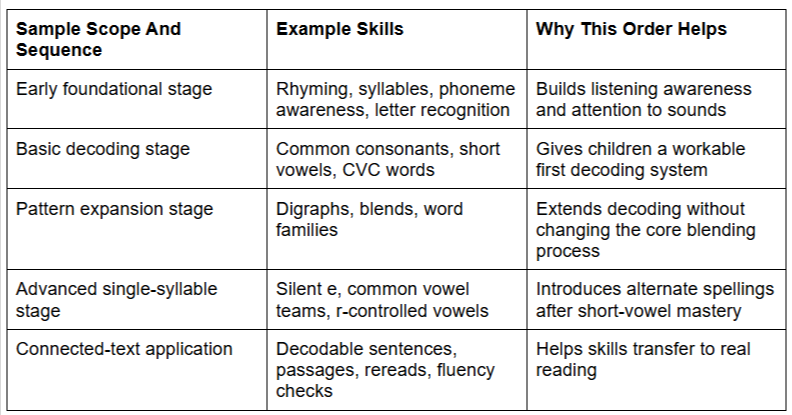
For schools and homeschool families, that structure also makes planning easier. Adults can see where the child entered, what has been mastered, and what should come next. The takeaway is that sequencing is not a technical detail. It is the backbone of instructional quality.
Phonics Reading: Why Do Decodable Texts Matter So Much For Transfer?
Phonics for reading improves when children can apply newly taught patterns to connected text instead of practicing only isolated words. This is one of the clearest dividing lines between a phonics tool that builds transferable reading skill and one that stays stuck at the drill level.
The What Works Clearinghouse explicitly recommends that students read connected text every day to support accuracy, fluency, and comprehension. That recommendation matters because children need to experience the payoff of decoding. They need to see that the same sound-spelling knowledge used in a word-building task can unlock a sentence, then a short story, then a longer passage.
That is where decodable texts become so valuable. A decodable passage keeps most words within patterns the learner has already been taught. This reduces unnecessary guessing and gives the child a real chance to feel successful while still reading meaningful text. In the brief, Readability provides controlled passages, on-the-spot word help, and read-aloud support. Used well, those features can help a child pause, decode, reread, and maintain the central point of reading: making meaning.
Research on orthographic mapping helps explain why this matters. Orthographic mapping is the process of storing a word in memory for instant retrieval by linking its spelling, pronunciation, and meaning. In other words, accurate decoding practice is not the opposite of fluent reading. It is one of the main roads that leads to fluent reading.
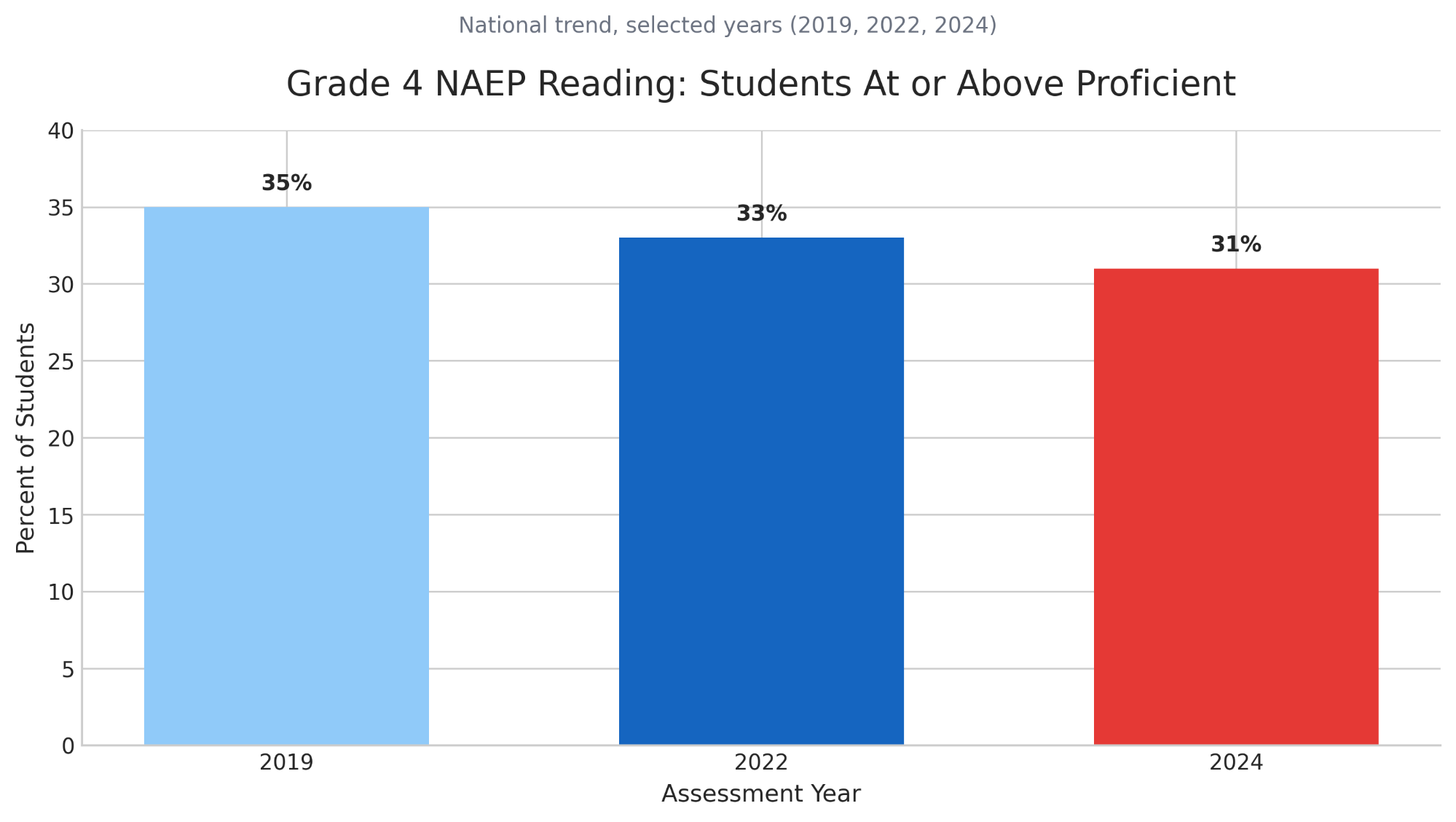
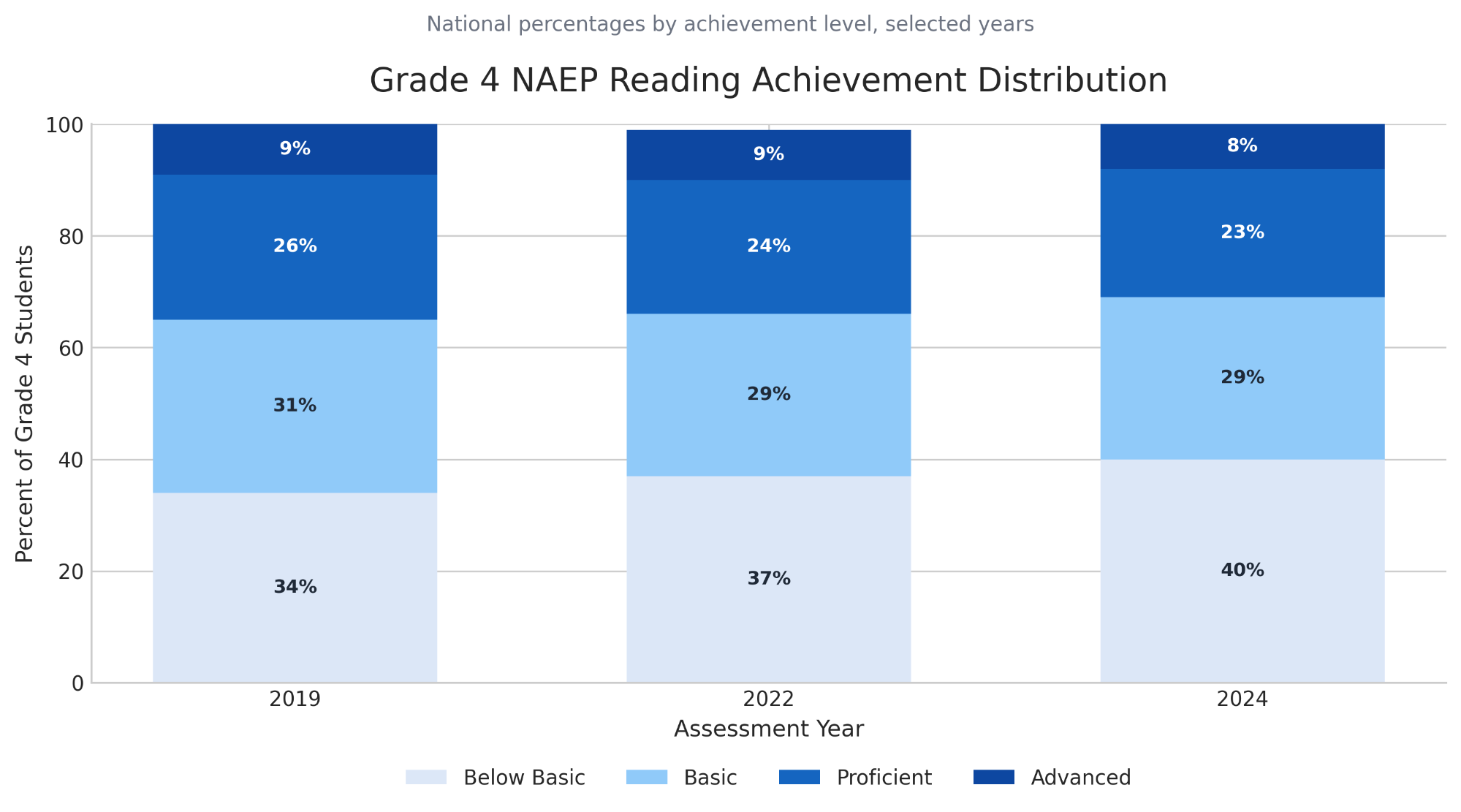
National reading trends add urgency to that point. In 2024, 31% of fourth-grade students performed at or above NAEP Proficient in reading, while 40% performed below NAEP Basic. Those figures do not prove that one app fixes the problem, but they do show why strong foundational support remains essential.
Children's Phonics Games: What Design Choices Help Young Learners Stay Focused?
Children's phonics games need to be built for young attention spans, emerging language skills, and beginner-level independence. Young learners benefit from uncluttered screens, large touch targets, predictable routines, and visual or audio cues that reduce confusion.
Readability offers simple user flows, clear directions, age-appropriate visuals, and vocabulary choices that support success rather than create extra barriers. That matters because a child should not have to decode the app before decoding the words on screen. If the interface is noisy or the task directions are unclear, the lesson becomes harder for reasons that have nothing to do with reading.
Another important design principle is motivational alignment. Rewards can help, but they should be tied to mastery rather than luck. A progress path, streak, or badge makes sense when it marks effort, completion, or improved accuracy. It becomes less useful when it distracts from the instructional objective. The best child-centered phonics games keep the child’s attention close to sounds, letters, and words.
This is also where accessibility matters. Headphone-friendly audio, caption support, and clear replay options help children who need extra listening support or who are working in different environments. For multilingual learners and children who benefit from repeated modeling, those supports can make practice more stable and less frustrating.
The takeaway is that child-friendly design should lower friction, not lower rigor.
Phonics Games For Kids: How Should Difficulty Build Without Causing Guessing Or Confusion?
Phonics games for kids should build confidence step by step. If the difficulty jumps too fast, children start guessing. If it stays too easy for too long, they disengage. The art of a good phonics app is to increase challenge while preserving a high chance of successful decoding.
In brief, this means starting with continuous consonants and short vowels, then widening to blends, digraphs, silent e, and later vowel patterns only after earlier knowledge is stable. That approach mirrors the logic of strong phonics instruction. A learner first needs to hear and blend the most useful and teachable patterns accurately. Only then should the app widen the complexity of the words it asks the child to read.
The takeaway is that gradual difficulty is not only about harder words. It is about protecting the accuracy of the decoding process as complexity increases.
Phonics Words: Which Word Sets Should Beginners Learn First?
Phonics words should be introduced in tightly controlled, high-utility sets so that children notice patterns rather than memorize isolated examples. This is why word families and carefully chosen decodable sets are so helpful. They let the learner hold one part steady while changing another, which makes the underlying pattern easier to see and hear.
A practical beginner sequence often starts with CVC patterns such as cat, sat, mat, then expands to other families such as bed, fed, pin, win, dog, log, and sun, fun. Once a child can decode those cleanly, instruction can broaden to digraphs like ship, shop, chin, rich, or wing, song, followed by blends such as stop, step, flag, flip, and crab, crib. Later, the child can move to long-vowel patterns such as make, bike, rope, rain, team, and boat.
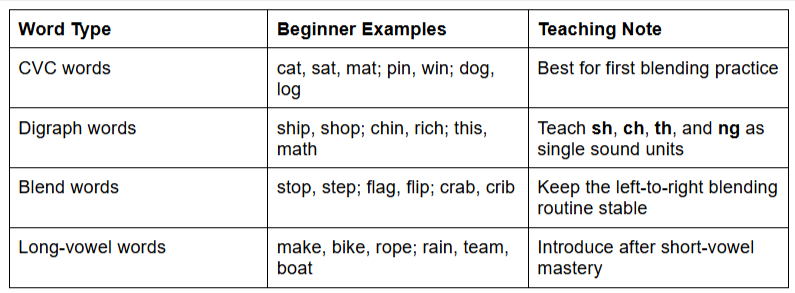
The underlying goal is not to expose children to as many words as possible. It is to expose them to words that make the pattern easier to learn. That is why a strong phonics app keeps its early word sets controlled, familiar, and easy to compare.
The takeaway is that a smaller, smarter word set often teaches more than a larger, messier one.
Phonics App: What Features Turn A Digital Tool Into A Real Reading Support?
A phonics app should combine explicit teaching, practice, connected-text application, and useful reporting in one coherent flow. If one of those pieces is missing, the tool may still be enjoyable, but it becomes less dependable as a serious reading support.
Readability’s core flow includes a warm-up or placement point, new-skill modeling, targeted games, aligned decodable reading, a quick check for understanding, and adult-facing progress data. That sequence is important because it mirrors how strong instruction works outside of technology as well. First the child is shown what to do. Then the child practices it in a controlled way. Then the child uses it in reading. Then the adult decides what should happen next.
That coherence matters more than the presence of any one feature. A decodable library is useful, but it is more useful when the passages align with the lesson progression. A pronunciation model is useful, but it is more useful when it connects to the child’s own attempts and highlights the exact pattern being learned. A dashboard is useful, but only if it tells parents and teachers what to review, not just how long the child stayed in the app.
In that sense, the best digital reading tools are not simply content containers. They are guided systems. The takeaway is that a phonics app becomes powerful when its features work together rather than sitting side by side.
What Does Readability Do For Families And Teachers Day To Day?
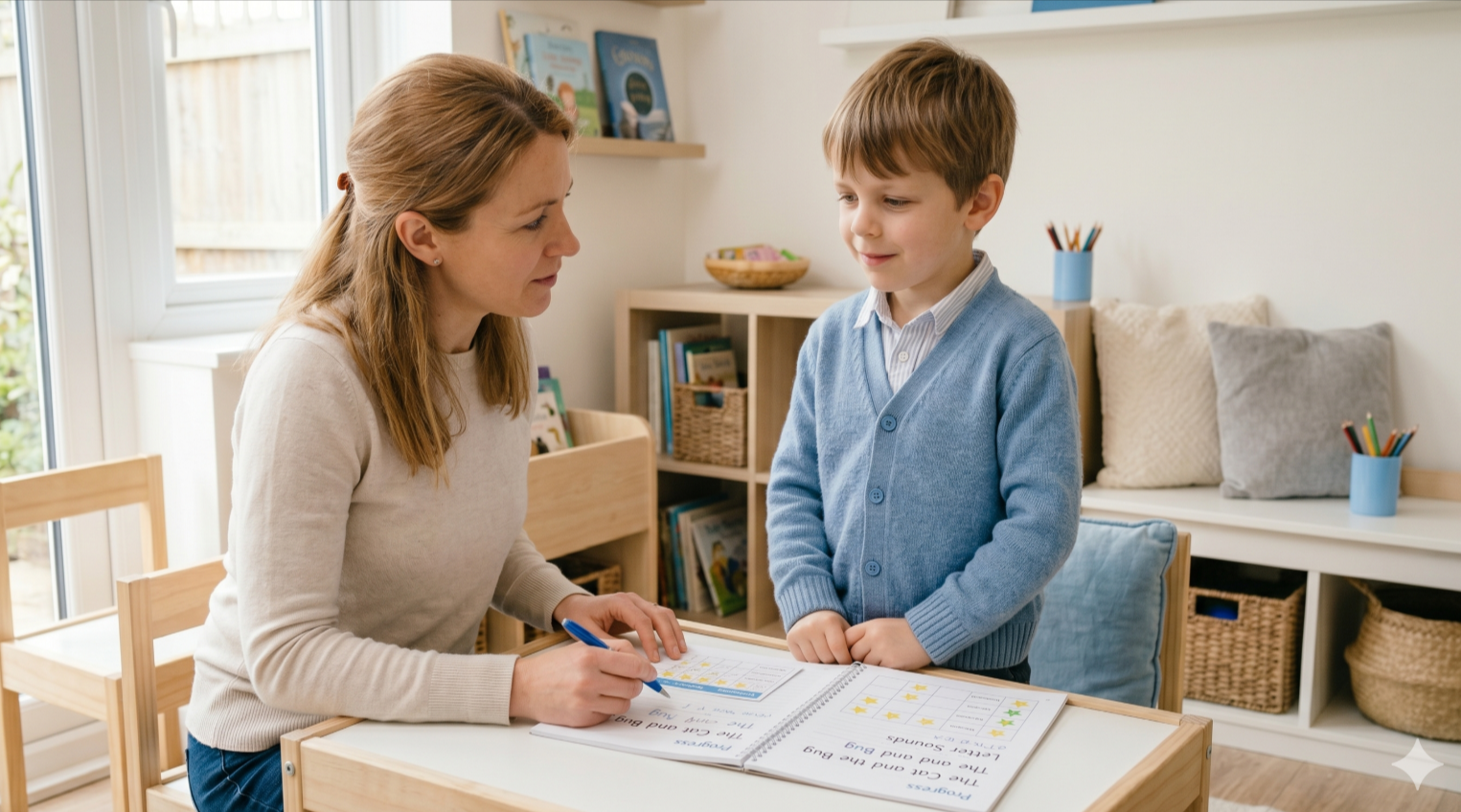
For a product like this to be useful beyond marketing language, it has to solve practical problems for adults as well as children. Families want to know whether practice is paying off. Teachers want to know whether the app aligns with classroom instruction. Tutors want a quick way to identify error patterns and plan the next lesson.
The brief suggests that Readability supports this by showing metrics such as accuracy, patterns mastered, words read, time on task, and recommended next steps. That matters because adults rarely need more raw data. They need usable signals. If a dashboard can show that a child is strong on short-vowel CVC words but still confusing sh and ch, the next session becomes easier to plan.
This is one reason progress tools matter for both home and school. At home, they help parents keep practice short and targeted rather than emotional and repetitive. In school, they help teachers use the app in small groups, intervention blocks, or station work without losing sight of which students need which patterns are taught. A well-built dashboard can also make conversations between adults more productive because it gives them a shared language for what the child is actually doing.
Why Does Evidence-Based Design Matter In Phonics Apps For Kids?
The phrase evidence-based can sound abstract, but in a phonics app it usually shows up in very concrete ways. It shows up in how sounds are modeled, in the order patterns are introduced, in whether words are decodable, in whether children read connected text, and in how feedback is delivered.
The National Reading Panel’s findings remain important because they draw a firm line between systematic phonics instruction and approaches that teach little or no phonics. The What Works Clearinghouse adds practical implementation guidance for kindergarten through third grade, especially around linking sounds to letters, teaching word reading explicitly, and ensuring students read connected text every day. Read together, those sources suggest that app quality should be judged by instructional architecture, not surface appeal.
Evidence-based design also helps adults avoid false choices. Phonics does not mean endless worksheets, and engagement does not require abandoning structure. A tool can be motivating and systematic at the same time. In fact, motivation often rises when children feel competent, and competence rises when tasks are well aligned to what they have already been taught.
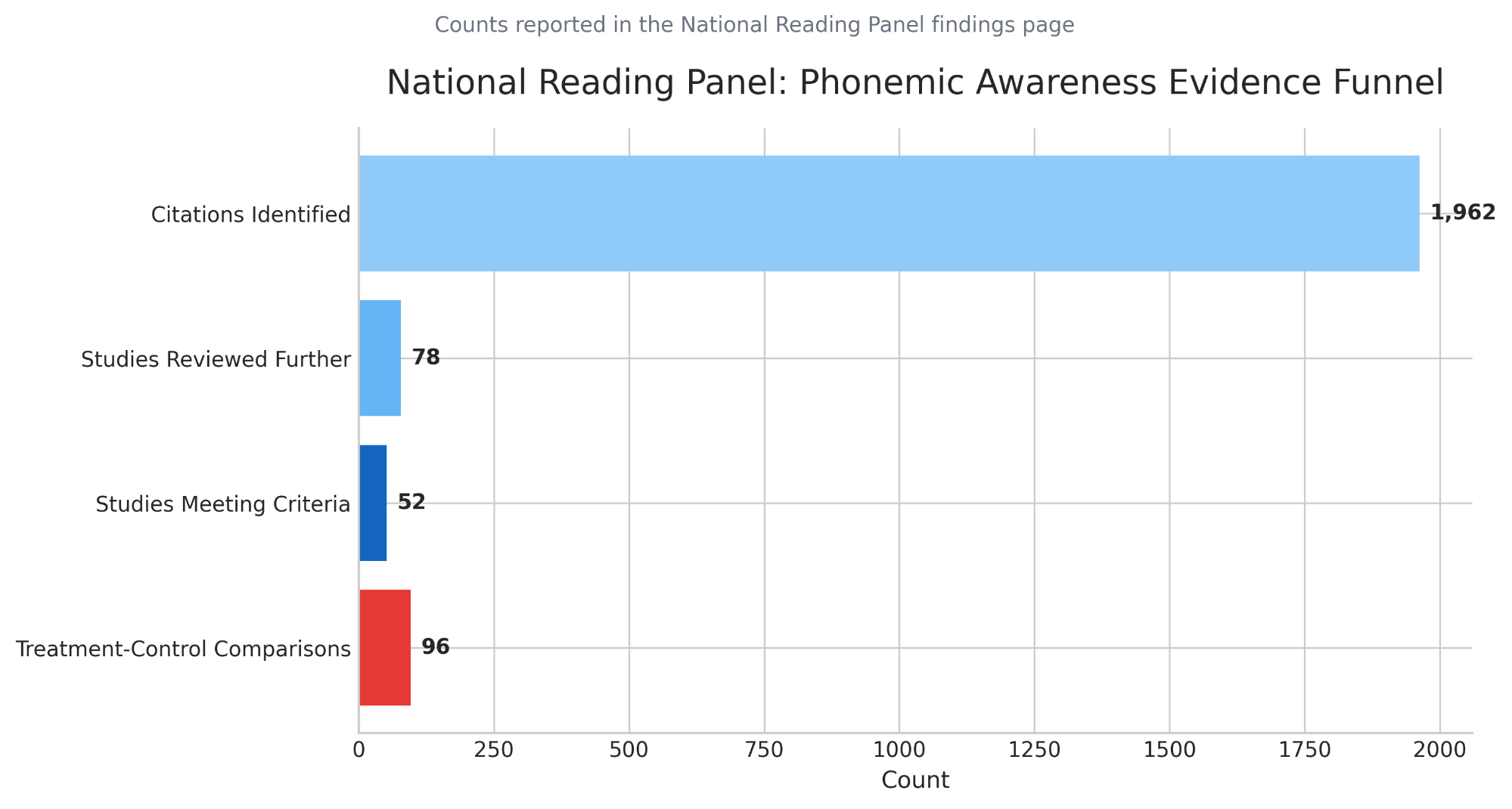
The National Reading Panel evidence base also helps show why this topic deserves attention. Its phonemic-awareness review began with 1,962 citations and narrowed to 52 studies meeting specific criteria, producing 96 treatment-control comparisons for analysis. That is not a casual or anecdotal base for decision-making.
The takeaway is that evidence-based design is not a slogan. It is a set of instructional choices that can be observed and evaluated.
How Does Progress Tracking Work For Parents, Teachers, And Tutors?
One of the most practical reasons families choose digital reading tools is that adults cannot always sit beside a child for every minute of practice. That makes progress tracking especially important. A good report should tell an adult not just that the child completed activities, but what the child can do independently, where errors cluster, and how much review is needed.
The brief suggests that Readability tracks metrics such as accuracy, patterns mastered, words read, time on task, and review recommendations. When those measures are tied to specific phonics skills rather than broad, vague labels, they become more actionable. A parent can see whether the child is ready to move from -at to mixed CVC sets. A teacher can decide whether a student needs more digraph work before joining a small group on blends. A tutor can explain progress in a way that feels concrete and reassuring.
Monitoring also matters because reading growth is rarely linear. Children often appear fluent on one set of words, then hit friction as soon as the pattern changes. Progress data helps adults understand whether that friction is normal transition, inattention, or a sign that the app should loop back to earlier practice.
What Is A Simple Daily Routine For Using Readability At Home Or School?
Most children do not need marathon app sessions. In fact, the brief recommends short daily use, often around 10 to 15 minutes, followed by one decodable text or passage. That is a sensible structure for early readers because it protects attention, keeps practice consistent, and leaves room for reading to remain fresh rather than draining.
A simple daily routine might begin with a one-minute sound warm-up, move into the day’s target lesson, continue with a few short game-based practice tasks, and end with a decodable page. If a parent is present, the final minute can be used to notice one success and one next step. If a teacher is using the app in rotation, the session can feed directly into a small-group review later in the day.
A weekly routine matters too. Adults can review the dashboard once or twice a week, check whether the child is still accurate on earlier patterns, and decide whether the next lessons should move forward or revisit trouble spots. This keeps the app from becoming passive background usage. Instead, it becomes part of a clear literacy routine.
Phonics Apps For Kids: What Should Families Remember Before They Choose?
When families compare phonics apps for kids, the most useful question is not, “Which one looks the most exciting?” It is, “Which one is most likely to teach my child accurately, clearly, and consistently?” That shift in focus makes the whole category easier to evaluate.
Readability is framed in this brief as a tool built around systematic phonics instruction, decodable reading practice, immediate feedback, and adult-facing progress data. Those are strong foundations because they reflect the main qualities identified in foundational reading research: explicit teaching, logical sequence, connected-text application, and opportunities for correction and review.
The larger context matters as well. National reading data show that many children still need stronger support, with only 31% of fourth graders at or above NAEP Proficient in reading in 2024 and 40% below NAEP Basic. That does not mean every child needs the same tool, but it does mean families and educators benefit from choosing tools carefully.
For most parents and teachers, the decision can come down to one practical standard: choose the tool that helps children hear sounds accurately, blend left to right, read what they have been taught, and show adults what to do next. If an app does that well, it is doing more than keeping a child busy. It is helping build the habits and knowledge that make independent reading possible.
FAQ: Phonics Apps for Kids
What Are Phonics Apps For Kids And How Do They Teach Reading?
Phonics apps for kids are digital tools that help children connect letters and letter patterns to speech sounds so they can decode words. The strongest ones combine explicit teaching, guided practice, decodable reading, and clear feedback rather than relying on games alone.
How Does A Phonics App Like Readability Teach Letter Sounds Accurately?
A strong phonics app models sounds cleanly, avoids added vowel sounds on stop consonants, and teaches digraphs such as sh and th as sound units. It then gives children repeated chances to hear, identify, blend, and read those patterns in words and text.
What Makes A Phonics Program Effective For Kindergarten And First Grade?
The evidence points to systematic sequence, explicit decoding instruction, and daily connected-text reading as core features of an effective early phonics program. For young learners, short lessons, cumulative review, and adult progress visibility also help.
Are Phonics Games Enough To Help My Child Read Words And Sentences?
Not by themselves. Phonics games can reinforce important skills, but children also need direct teaching, decodable reading, rereading, and feedback that explains what went wrong and what to try next.
How Do Phonics For Kids And Phonemic Awareness Fit Together?
Phonemic awareness helps children hear and manipulate the sounds in spoken words, while phonics connects those sounds to letters in print. Together, they support decoding, spelling, and the development of automatic word recognition.
What Are The Best Ways To Teach Blending In A Phonics Reading Lesson?
Teach blending from left to right, model sounds accurately, and begin with controlled words that match the child’s current skill level. It also helps to avoid pronouncing silent letters and to keep the learner’s attention on one new pattern at a time.
Which Children's Phonics Games Work Well For Ages 4 To 7?
The most useful games for this age group are short, simple, and tightly linked to instruction. Sound matching, tap-to-hear models, drag-to-blend tasks, and word-building games usually work better than broad reading games that do not target a specific decoding skill.